Architecture
Deep dive into unbounded-net system design, dataplane, data flows, and security.
This document provides a detailed overview of unbounded-net’s architecture, components, and their interactions. For a conceptual introduction, see the Networking Concepts page.
System Overview
unbounded-net provides seamless pod-to-pod networking across multiple Kubernetes sites using encrypted (WireGuard) or unencrypted (GENEVE, VXLAN, IPIP) tunnels. The encapsulation type is selected per link scope and can be set explicitly or resolved automatically based on link characteristics.
The eBPF dataplane uses a TC egress BPF program and LPM trie maps for tunnel endpoint resolution.
High-Level Architecture
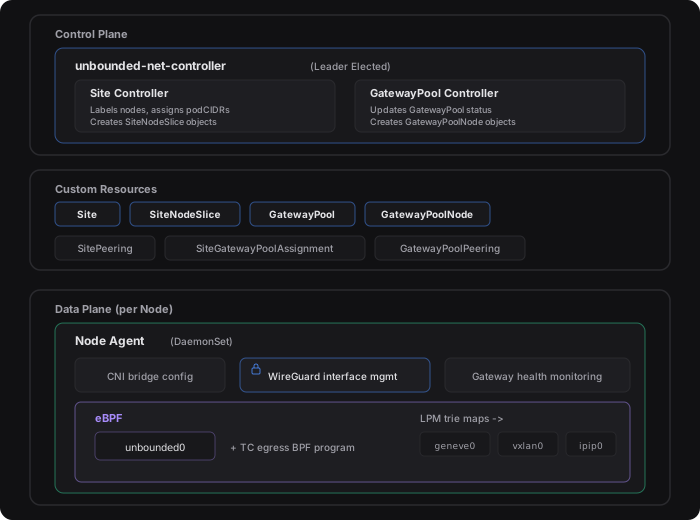
Component Details
Controller (unbounded-net-controller)
The controller runs as a Deployment with 2 replicas for high availability. Only the leader actively reconciles resources.
Pod CIDR Assignment
Pod CIDRs are assigned by the Site controller based on per-site assignment rules:
- When a node is created or updated, the controller checks if it already has pod CIDRs.
- If not, it finds the matching Site based on the node’s internal IP.
- It selects an assignment by priority and node name regex.
- A fresh API fetch is performed before allocation to prevent double-allocation from stale informer cache.
- The controller allocates from the assignment’s CIDR pools and patches the node.
- If a CIDR pool is exhausted, the controller exits fatally to surface the problem immediately.
Site Controller
Manages site membership and SiteNodeSlice objects:
- Matches node internal IPs against Site
nodeCidrs. - Labels matching nodes with
unbounded-cloud.io/site=<name>. - Splits site nodes into SiteNodeSlice objects (max 500 nodes per slice to avoid etcd object size limits).
- Slices are named
{site-name}-{index}with OwnerReferences for automatic garbage collection.
GatewayPool Controller
Maintains gateway node information:
- Lists nodes matching the pool’s label selector.
- Filters for nodes with external IPs and WireGuard keys.
- Calculates health endpoints.
- Updates pool status with gateway node details.
Node Agent (unbounded-net-node)
The node agent runs as a DaemonSet on every node, including control plane nodes. It manages:
- WireGuard interfaces and key management
- Tunnel configuration
- eBPF program lifecycle and BPF map reconciliation
- Route programming
- CNI bridge configuration
- Gateway health monitoring
Initialization Flow
- Check for existing WireGuard keys on the filesystem; generate if missing.
- Annotate the node with the WireGuard public key.
- Wait for podCIDRs to be assigned by the controller.
- Write CNI configuration atomically.
- Start watching Site, SiteNodeSlice, and GatewayPool resources.
- Configure WireGuard and tunnel interfaces.
WireGuard Interface Architecture
Regular nodes use:
wg51820(port 51820) for intra-site mesh peers.wg51821,wg51822, … for dedicated gateway connections (one interface per gateway peer).
Gateway nodes use:
wg51820for all peers (same-site and remote). Remote peers have no endpoint set – WireGuard learns their address from incoming packets.
Running with an Existing CNI
unbounded-net can run alongside a CNI you already operate in the primary cluster
(for example Cilium, Calico, or Azure CNI). In this mode the existing CNI keeps
ownership of intra-site pod networking, and unbounded-net is responsible only for
connecting remote sites back to the primary cluster. This is controlled per-Site
with the manageCniPlugin field.
Configuring the Primary Site
For the Site that maps to your existing cluster, set manageCniPlugin: false.
This disables pod CIDR assignment by default. An explicit
assignmentEnabled: true on a podCidrAssignments rule still enables assignment
without managing the existing CNI. The
podCidrAssignments block is still required: it defines the CIDR ranges that the
other sites and gateways use to route traffic back to the primary cluster’s pods.
apiVersion: net.unbounded-cloud.io/v1alpha1
kind: Site
metadata:
  name: primary
spec:
  nodeCidrs:
    - "10.224.0.0/16"
  # CNI already runs in this cluster, so unbounded-net does not write CNI
  # config or mesh same-site nodes, and pod CIDR assignment is disabled.
  manageCniPlugin: false
  podCidrAssignments:
      # Omitted assignmentEnabled inherits false, but the CIDR
      # range is still declared so other sites can route to these pods.
    - cidrBlocks:
        - "10.244.0.0/16"
When initializing the site with the CLI, pass --manage-cni-plugin=false so the
generated Site resource is configured the same way. See the
Bring Your Own Cluster guide for the
end-to-end workflow.
Division of Responsibilities
| Concern | Existing CNI | unbounded-net |
|---|---|---|
| Pod IPAM and pod CIDR allocation in the primary cluster | ✓ | |
| CNI configuration on primary-site nodes | ✓ | |
| Intra-site pod-to-pod networking within the primary cluster | ✓ | |
| Cross-site routing to and from remote sites | ✓ | |
| Gateway WireGuard tunnels between sites | ✓ | |
| Pod CIDR allocation and CNI config on remote sites | ✓ |
The existing CNI continues to handle everything inside the primary cluster: allocating pod IPs, writing its own CNI configuration, and forwarding pod-to-pod traffic between local nodes. unbounded-net does not write CNI config, mesh same-site peers, or allocate pod CIDRs for that site.
unbounded-net handles only inter-site connectivity for the primary site: it brings up gateway WireGuard tunnels to other sites and programs the routes that carry traffic to and from remote pod CIDRs. Remote sites created by Unbounded are unaffected; on those sites unbounded-net continues to act as the CNI, allocate pod CIDRs, and mesh same-site nodes as usual.
toCIDR/fromCIDR) rather than by identity or label selectors.Encapsulation Types
| Type | Overhead | Encrypted | Default For |
|---|---|---|---|
| WireGuard | 80 bytes | Yes | External/public IP links |
| GENEVE | 58 bytes | No | Internal/private IP links |
| VXLAN | ~58 bytes | No | Links with NIC hardware offload |
| IPIP | 20 bytes | No | Minimal overhead links |
| None | 0 bytes | No | Direct L3 routing |
The tunnelProtocol field on CRD specs controls selection. When set to Auto
(default), the system chooses based on link characteristics. The
security-wins rule ensures that if any scope explicitly sets WireGuard,
the link uses WireGuard regardless of other scopes.
See Routing Flows for the full protocol selection algorithm.
Tunnel Dataplane
Uses a single dummy device (unbounded0) as a routing anchor, a TC egress BPF
program for tunnel endpoint resolution, and shared flow-based tunnel interfaces.
Key interfaces:
| Interface | Purpose |
|---|---|
unbounded0 | Dummy (NOARP) device. Holds overlay IPs and supernet routes. TC egress BPF attached here. |
geneve0 | Flow-based GENEVE. BPF sets remote endpoint and VNI via bpf_skb_set_tunnel_key(). |
vxlan0 | Flow-based VXLAN. Same metadata-driven approach as GENEVE. |
ipip0 | Flow-based IP-in-IP. Tunnel key sets the remote endpoint. |
wg<port> | WireGuard. BPF performs redirect-only (no tunnel key). Crypto routing handled by WireGuard AllowedIPs. |
BPF LPM Trie Map
A single unified trie stores overlay CIDR to tunnel endpoint mappings:
| Map | Key Size | Description |
|---|---|---|
unb_endpts | 20 bytes | 16-byte address + 4-byte prefixlen; IPv4 entries use IPv4-mapped IPv6 form |
BPF_MAP_TYPE_LPM_TRIE with a default max of 16,384 entries. IPv4 destinations
are stored as ::ffff:<v4> with prefixlen offset by 96, so the trie’s
longest-prefix-match naturally segregates v4 from native v6 entries.
Each nexthop contains:
- Remote endpoint (16 bytes): underlay address, IPv4-mapped for v4 underlays.
- Interface index: target tunnel interface for
bpf_redirect(). - Healthy (u32): non-zero when eligible; only consulted by multi-nexthop ECMP (gateway pools).
- Protocol: GENEVE=1, VXLAN=2, IPIP=3, WireGuard=4, None=5. The BPF
program derives whether to call
bpf_skb_set_tunnel_key(GENEVE/VXLAN/IPIP) from this field.
Deterministic MAC Derivation
Both the BPF program and Go code derive inner Ethernet destination MACs deterministically from the destination IP:
- IPv4:
02:<ip[0]>:<ip[1]>:<ip[2]>:<ip[3]>:FF - IPv6:
02:<last 4 bytes>:FF
This avoids ARP/ND on tunnel interfaces.
BPF Map Reconciliation
Entries are not applied incrementally. Each protocol appends entries to a
pending map, then a single Reconcile() call atomically deletes stale entries
and upserts desired entries, keeping IPv4 and IPv6 tries synchronized.
Data Flows
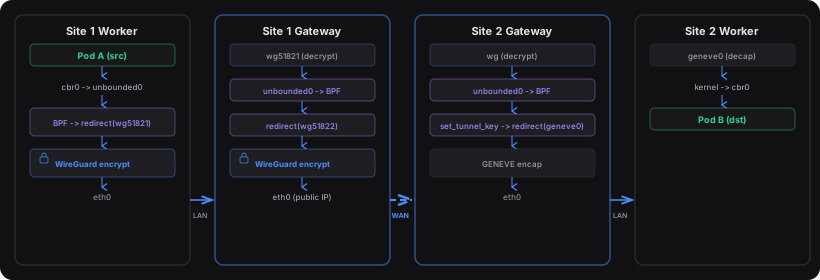
Same-Site Pod-to-Pod (GENEVE)

Cross-Site Pod-to-Pod (via Gateway, WireGuard)
Gateway Health Checks
Node agents send UDP probes over WireGuard tunnels at configurable intervals
(default 15s). Failure detection uses detectMultiplier * max(transmitInterval, receiveInterval), which is 45s with the default multiplier of 3. On failure,
route metrics are increased to deprioritize unhealthy paths. On recovery,
metrics are restored.
Status Aggregation
Node agents push status to the controller every 10 seconds (gzip JSON, Bearer token auth). The controller caches status and broadcasts delta-compressed updates to WebSocket dashboard clients every 3 seconds.
Security Model
WireGuard Key Management
- Private keys stored at
/etc/wireguard/server.priv(mode 0600). - Public keys published as node annotations.
- Peer authentication via AllowedIPs and public key verification.
- No pre-shared keys used.
Unencrypted Tunnel Note
GENEVE, VXLAN, IPIP, and None tunnels provide no encryption. They are designed
for trusted internal networks. The Auto mode ensures links crossing untrusted
boundaries (external IPs) automatically use WireGuard. The security-wins
hierarchy prevents accidental downgrade.
RBAC
Controller requires: Nodes (get/list/watch/patch/update), Sites and GatewayPools (get/list/watch + status), SiteNodeSlices and GatewayPoolNodes (full access), Leases (leader election), CRDs (get/create), EndpointSlices (CRUD), TokenReviews (create).
Node Agent requires: Nodes (get/watch/patch), Sites/SiteNodeSlices/ GatewayPools/SitePeerings/SiteGatewayPoolAssignments/GatewayPoolPeerings (get/list/watch), GatewayPoolNodes (get/list/watch/create/update).
Gateway Node Isolation
Gateway nodes are tainted with
net.unbounded-cloud.io/gateway-node=true:NoSchedule to prevent regular
workloads from being scheduled on them, since gateways lack pod CIDR routes to
other sites.
Failure Modes
Controller Failure
The controller uses leader election. On failover, the new leader re-initializes allocator state from existing node objects. Follower replicas pass health checks and are ready for immediate failover.
Gateway Failure
Gateways start in a “New” state and must prove connectivity before being marked healthy. The state machine:
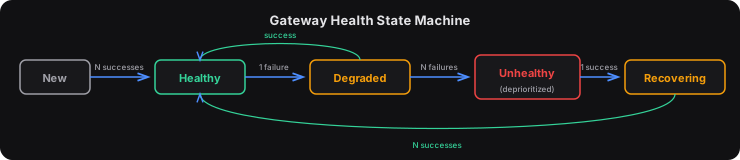
Recovery requires the same number of successes as failures to go down (symmetric recovery).
Network Partition
Intra-site traffic continues to work. Cross-site traffic fails until the partition heals. ECMP across multiple gateways provides resilience against single-gateway failures.
Performance Considerations
- Informer-based architecture: Watch-based updates with local caching.
- Differential updates: All managers (WireGuard, routes, links, BPF maps, masquerade, ECMP) use delta reconciliation – only adding, updating, or removing what changed.
- ECMP load balancing: Multiple gateway interfaces enable kernel-level ECMP via netlink nexthop groups.
Next Steps
- Custom Resources – Full CRD specifications.
- Configuration – All flags and settings.
- Routing Flows – Packet-level routing details.
- Operations – Deployment and troubleshooting.