NVIDIA GPU Support
How the unbounded-agent discovers, configures, and exposes NVIDIA GPUs to Kubernetes workloads.
The unbounded-agent automatically detects NVIDIA GPUs on the host, forwards the driver’s userspace libraries into the nspawn container, generates a CDI specification, and configures containerd so that GPU workloads can be scheduled on the node.
Prerequisites
Before the agent can expose GPUs, the host VM must have:
- NVIDIA kernel drivers loaded.
/dev/nvidia*device nodes must exist. - NVIDIA userspace libraries installed.
ldconfig -pmust listlibcuda,libnvidia-ml, and related libraries. - Fabric Manager running (NVSwitch-based GPUs only). H100, H200, and
multi-GPU ND A100 systems require the
nvidia-fabricmanagerservice. Without it, CUDA initialization fails with error 802 (SYSTEM_DRIVER_MISMATCH). - Persistence mode enabled.
nvidia-smi -pm 1keeps the driver loaded between GPU process invocations and avoids cold-start latency.
The GPU OCI images (agent-ubuntu2404-nvidia, agent-ubuntu2604-nvidia,
agent-azlinux3-nvidia) include the NVIDIA Container Toolkit (nvidia-ctk,
nvidia-container-runtime) but not the kernel driver or userspace
libraries. Those come from the host.
How It Works
The agent’s GPU support spans two bootstrap phases: rootfs (nspawn configuration) and node-start (runtime setup inside the container). The full sequence is:
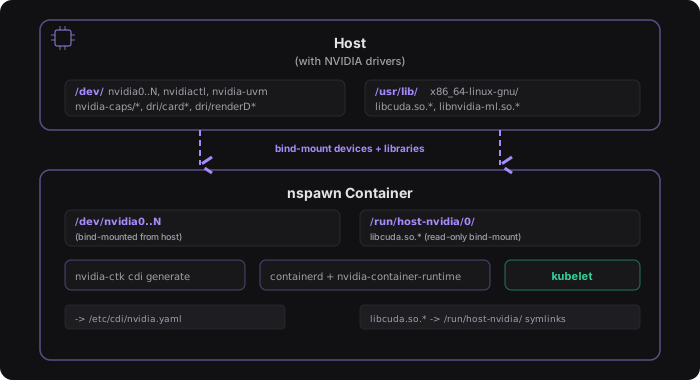
- Device discovery. Scans
/devfor NVIDIA device nodes (per-GPU, control, UVM, capability, and DRI render nodes). If none are found, the entire GPU pipeline is skipped. - Library discovery. Queries
ldconfig -pon the host and filters for NVIDIA libraries matching the host architecture. Deduplicates parent directories and assigns each a numbered mount index. - nspawn configuration. Writes device bind-mounts, read-only library
bind-mounts at
/run/host-nvidia/<index>/, andDeviceAllowcgroup entries into the nspawn and systemd service override configs. - NVIDIA setup. After the nspawn boots, creates symlinks in the
container’s multiarch library directory pointing into
/run/host-nvidia/, then prepares/run/nvidia/driverfor NVIDIA container tooling and device plugins. The driver root contains copied 64-bit NVIDIA and VDPAU libraries,nvidia-smiwhen present on the host, optional matching i386 libraries, and multiarch compatibility symlinks. The agent then runsldconfigandnvidia-ctk cdi generateto produce the CDI spec at/etc/cdi/nvidia.yaml. Most CDI hooks are disabled to avoid interference with the nspawn environment. - containerd runtime configuration. Writes a containerd drop-in that
enables CDI support and registers the
nvidiaruntime class. - kubelet GPU advertisement. Once kubelet starts and a user-deployed
NVIDIA device plugin is running, GPUs are registered as
nvidia.com/gpuextended resources on the node.
Prepared Driver Root
CDI generation is explicitly directed at the host-derived driver root:
nvidia-ctk cdi generate \
  --driver-root=/run/nvidia/driver \
  --dev-root=/ \
  --output=/etc/cdi/nvidia.yaml
--driver-root makes nvidia-ctk discover userspace libraries, linker data,
and helper binaries from /run/nvidia/driver instead of the nspawn OCI
filesystem. This prevents the generated CDI specification from depending on
libraries in the image that may be absent or may not match the host kernel
driver. --dev-root=/ is separate: NVIDIA device nodes are bind-mounted at
their normal paths in the nspawn machine, so device discovery remains rooted
at /.
The prepared root includes etc/ld.so.cache so nvidia-ctk can resolve the
copied libraries and their SONAME aliases. When the host provides
nvidia-smi, the agent also copies that host-matched binary to
/run/nvidia/driver/usr/bin/nvidia-smi. Because helper discovery is scoped by
--driver-root, this copy allows the CDI specification to expose a
version-compatible nvidia-smi to GPU containers. The binary is useful for
diagnostics and monitoring but is not required for compute-only CUDA access.
Architecture Support
Library discovery is architecture-aware. The agent uses runtime.GOARCH to
select the correct multiarch library path and ldconfig filter:
| GOARCH | ldconfig tag | Library directory |
|---|---|---|
amd64 | x86-64 | /usr/lib/x86_64-linux-gnu |
arm64 | aarch64 | /usr/lib/aarch64-linux-gnu |
GPU OCI Image
The GPU rootfs images (images/agent-ubuntu2404-nvidia/Containerfile,
images/agent-ubuntu2604-nvidia/Containerfile, and
images/agent-azlinux3-nvidia/Containerfile) extend the standard agent base
images with the NVIDIA Container Toolkit:
nvidia-container-runtime: OCI runtime wrapper that injects GPU devices.nvidia-ctk: generates CDI specifications from discovered hardware.libnvidia-container: low-level library for GPU container setup.
The image does not include NVIDIA kernel drivers or userspace libraries. Those are forwarded from the host at boot time via the bind-mount mechanism described above.
Troubleshooting
CUDA error 802 (SYSTEM_DRIVER_MISMATCH)
This means Fabric Manager is not running. It is required for NVSwitch-based multi-GPU systems (H100, H200, ND A100):
sudo systemctl status nvidia-fabricmanager
sudo systemctl start nvidia-fabricmanager
nvidia-ctk cdi generate fails with ERROR_LIBRARY_NOT_FOUND
The host NVIDIA libraries are not visible inside the nspawn. Check that:
- The bind-mounts in the
.nspawnconfig include the host library directory. - The symlinks in the container’s multiarch lib dir point to valid paths
under
/run/host-nvidia/. ldconfigwas run after symlink creation.
CDI spec has no device entries
Ensure the kernel driver is loaded (lsmod | grep nvidia) and that
/dev/nvidia0 exists. If the driver is installed but not loaded, reboot the
host.