systemd-nspawn Isolation
How the unbounded-agent uses systemd-nspawn to isolate Kubernetes worker node components.
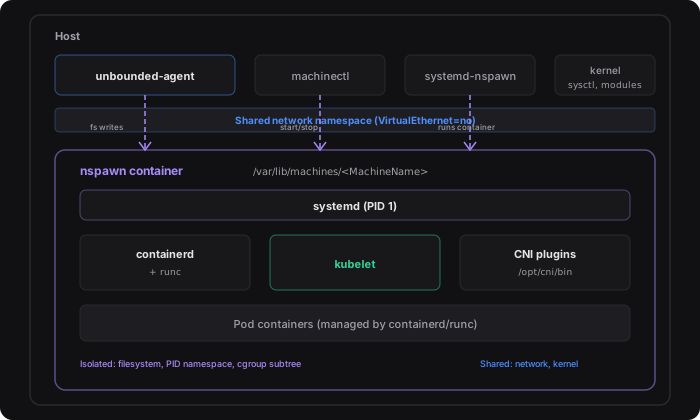
The unbounded-agent runs all Kubernetes worker node components inside a systemd-nspawn container. This provides lightweight OS-level isolation (separate filesystem, PID, and cgroup namespaces) while sharing the host kernel. The container runs a full systemd init tree so that kubelet, containerd, and their dependencies are managed as regular systemd services, decoupled from anything running on the host.
Why nspawn
Running kubelet directly on the host requires careful package management and risks conflicting with existing services. An nspawn container gives the agent a clean, reproducible environment:
- Filesystem isolation. Kubernetes binaries, configuration, and runtime state live inside the container’s rootfs and do not interfere with the host.
- Process isolation. The container has its own PID namespace. A full systemd instance (PID 1 inside the container) supervises containerd and kubelet with automatic restart policies.
- Cgroup isolation. The container gets its own cgroup subtree. Nested containers (pods) created by runc operate under cgroups v2 inside this subtree.
- Shared network namespace. The container shares the host’s network stack
(
VirtualEthernet=no), so kubelet uses the host’s routable IP directly and CNI plugins can create interfaces (WireGuard tunnels, overlay bridges) that are visible on the host. - Simplified upgrades. Upgrading Kubernetes is a matter of replacing the container rootfs and restarting the nspawn machine. The host OS remains untouched, eliminating the need to coordinate package upgrades across the host and the node stack.
Container Rootfs
The rootfs is a plain directory tree at /var/lib/machines/<MachineName>. It
is created during the rootfs bootstrap phase by pulling a pre-built OCI
image via ORAS and unpacking it into the machine directory. A GPU variant
includes the NVIDIA Container Toolkit.
After the rootfs exists, the agent downloads Kubernetes binaries (kubelet,
kubectl, kube-proxy), containerd, runc, and CNI plugins directly into
the rootfs before the container boots. Configuration files (containerd
config, kubelet service units, bootstrap kubeconfig, CA certificates, hostname,
and resolv.conf) are also written into the rootfs at their standard
absolute paths (e.g. /var/lib/machines/<MachineName>/etc/containerd/config.toml
becomes /etc/containerd/config.toml inside the container).
OCI Images
The default rootfs image is selected automatically based on the host distro and whether NVIDIA GPUs are detected on the host. Supported automatic matches are Ubuntu 24.04, Ubuntu 26.04, and Azure Linux 3.0. RPM-based hosts fall back to Azure Linux 3.0. Other unknown host distros fall back to Ubuntu 24.04.
| Image | Default repository | Description |
|---|---|---|
agent-ubuntu2404 | ghcr.io/azure/agent-ubuntu2404 | Base image with systemd, dbus, curl, iproute2, nftables, kmod, wireguard-tools, and bpftool. (Containerfile) |
agent-ubuntu2404-nvidia | ghcr.io/azure/agent-ubuntu2404-nvidia | Extends the base image with the NVIDIA Container Toolkit (nvidia-ctk, nvidia-container-runtime). (Containerfile) |
agent-ubuntu2604 | ghcr.io/azure/agent-ubuntu2604 | Ubuntu 26.04 base image with systemd, dbus, curl, iproute2, nftables, kmod, wireguard-tools, and bpftool. (Containerfile) |
agent-ubuntu2604-nvidia | ghcr.io/azure/agent-ubuntu2604-nvidia | Ubuntu 26.04 image with the NVIDIA Container Toolkit (nvidia-ctk, nvidia-container-runtime). (Containerfile) |
agent-azlinux3 | ghcr.io/azure/agent-azlinux3 | Azure Linux 3.0 base image with systemd, dbus, curl, iproute, nftables, kmod, wireguard-tools, and bpftool. (Containerfile) |
agent-azlinux3-nvidia | ghcr.io/azure/agent-azlinux3-nvidia | Azure Linux 3.0 image with the NVIDIA Container Toolkit (nvidia-ctk, nvidia-container-runtime). (Containerfile) |
The agent pins a specific image tag by default at build time. The OCIImage
field in the agent config can select a registry image, a local OCI layout, or a
tarred OCI image layout downloaded over HTTPS. For example:
ghcr.io/azure/agent-ubuntu2404:v20260619
oci-layout:///opt/unbounded/images/agent-ubuntu2404:v20260619
https://artifacts.example.com/agent-ubuntu2404.oci.tar
HTTPS archives may be plain tar or gzip-compressed tar files. They must contain
an OCI image layout with oci-layout, index.json, and blobs/ content, and
exactly one tagged image reference. The agent selects that reference automatically.
Signed query strings such as Azure Blob SAS parameters are supported and are
redacted from logs and errors.
Image sources are maintained in the images/ directory of the repository.
Machine Configuration
The agent configures the nspawn machine to share the host network namespace
(VirtualEthernet=no) so that kubelet uses the host’s routable IP directly and
CNI plugins can manage interfaces visible on the host. It also makes
/proc/sys/net writable inside the container so that CNI plugins and
kube-proxy can set network sysctls, while the rest of /proc/sys stays
read-only. Cgroups v2 is forced inside the container to ensure consistent
behavior regardless of the systemd version in the rootfs.
The default systemd-nspawn@.service launcher may still show flags such as
--network-veth. Those flags come from the systemd template, but the generated
.nspawn file is written to the trusted /etc/systemd/nspawn/ directory and
the template runs with --settings=override. As a result, the generated
VirtualEthernet=no setting is authoritative and the machine shares the host
network namespace. Host interfaces, host firewall and routing rules, and
loopback listeners are therefore visible from inside the nspawn machine.
When GPUs are detected on the host, the agent automatically exposes the host paths needed by the corresponding Kubernetes device plugin:
- NVIDIA GPUs. Bind-mounts GPU device nodes and host driver libraries, including NVIDIA IMEX channel devices used by multi-node GPU and NVLink communication, grants cgroup device permissions, generates a CDI spec, and configures the NVIDIA container runtime. See NVIDIA GPU Support.
- AMD GPUs. Bind-mounts
/dev/kfdand DRM device nodes, grants cgroup device permissions, and exposes AMD sysfs paths read-only so the AMD Kubernetes device plugin can discover GPUs inside nspawn. See AMD GPU Support.
When virtualization device nodes are present on the host, the agent automatically bind-mounts them into the container and grants cgroup device permissions so that workloads inside the container can run virtual machines:
/dev/kvmfor hardware virtualization (for example QEMU/KVM)./dev/net/tunfor TAP interfaces used by VM networking./dev/vhost-netfor accelerated VirtIO networking.
The agent also auto-mounts host storage and InfiniBand hardware:
- Block (storage) devices. Every entry under
/sys/class/blockis bind-mounted by its device node (e.g./dev/sda,/dev/sda1,/dev/nvme0n1,/dev/nvme0n1p1), including whole disks and their partitions as well as device-mapper (/dev/dm-*) and software RAID (/dev/md*) nodes. Pseudo and virtual devices are excluded:loop*,ram*,zram*,fd*, andsr*(optical). - InfiniBand HCA devices. Every character device under
/dev/infiniband(e.g.uverbs0,umad0,issm0,rdma_cm) is bind-mounted so that RDMA workloads inside the container can reach the host’s HCAs. - Configured extra devices.
AdditionalHostDevicescan list either non-standard host device nodes under/dev, such as/dev/uinput, or systemd device group specifiers, such aschar-input,char-pts, andblock-*. Device paths are bind-mounted and granted withDeviceAllow=. Group specifiers are rendered only asDeviceAllow=rules. - Configured extra mounts.
AdditionalHostMountsbinds non-device host files or directories into the machine.Sourcemust be a clean absolute path (no.,.., or repeated slashes, no whitespace, control characters, or:).Targetis also a clean absolute path and defaults toSourcewhen omitted. SetReadOnlytotrueunless the machine requires write access. Sources are not created or required to exist during config validation.
Two systemd hooks run common lifecycle reconciliation around every nspawn
start. The pre-start hook refreshes host devices, mounts, and GPU paths changed
by a host reboot. On GPU hosts, the post-start hook stops kubelet and containerd,
rewires the driver root and CDI state, then restores both services. Hook failures
fail the nspawn start and are retried through systemd. On the host,
unbounded-agent-nspawn-lifecycle nspawn-lifecycle reconcile <machine> triggers both
steps by restarting the managed nspawn unit. Managed NodeReboot operations
invoke the same reconcile flow.
Each lifecycle refresh discovers NVIDIA devices and driver libraries from the current host. On a node provisioned with the NVIDIA-capable rootfs, complete GPU discovery runs post-start rewiring, while incomplete driver state causes the start to retry. Adding a GPU to a node provisioned with the CPU rootfs is not an in-place migration path: that rootfs does not contain the required NVIDIA tools or containerd runtime configuration. Reinitialize or repave the node with the NVIDIA-capable rootfs image instead. Post-start rewiring refreshes the driver root and CDI state after every machine start.
When an upgraded daemon starts for a machine created by an older agent, it idempotently installs the host lifecycle hooks without restarting the running machine or its services. The daemon migration uses the same current-host discovery and fails explicitly if NVIDIA devices have incomplete driver state.
During the first bootstrap, the applied config is persisted only after the node
starts successfully. If the host reboots before that point, pre-start keeps the
configuration generated by the in-progress bootstrap because there is no
persisted config to resolve again. If that interrupted bootstrap does not
complete successfully, recover by resetting the partial agent deployment and
running bootstrap again from a clean state. NodeReboot is intended for
machines that completed bootstrap and already have an applied config; it is not
the recovery path for a partially provisioned first boot.
The configuration is written to these files on the host before the machine boots:
| File | Path |
|---|---|
| nspawn config | /etc/systemd/nspawn/<MachineName>.nspawn |
| Service override | /etc/systemd/system/systemd-nspawn@<MachineName>.service.d/override.conf |
| Config regeneration unit | /etc/systemd/system/unbounded-agent-regenerate-config@<MachineName>.service |
| Rollback-stable lifecycle helper | /usr/local/bin/unbounded-agent-nspawn-lifecycle |
Customization points
| Setting | File | Purpose |
|---|---|---|
Capability=all | nspawn config | Grants all capabilities for nested container runtimes (runc). |
PrivateUsers=no | nspawn config | Disables user namespace remapping so runc can use real root. |
SystemCallFilter=@keyring bpf perf_event_open | nspawn config | Allows kernel keyring, eBPF, and perf event syscalls used by containerd, runc, and eBPF CNIs. |
VirtualEthernet=no | nspawn config | Shares the host network namespace. |
Bind=/run/bpffs/<MachineName>:/sys/fs/bpf | nspawn config | Exposes a machine-scoped bpffs mount to eBPF CNIs such as Cilium. |
bpffs ExecStartPre= mount commands | Service override | Creates and mounts the machine-scoped host bpffs before the machine starts. |
SYSTEMD_NSPAWN_UNIFIED_HIERARCHY=1 | Service override | Forces cgroups v2 inside the container. |
SYSTEMD_NSPAWN_API_VFS_WRITABLE=network | Service override | Makes /proc/sys/net writable for CNI and kube-proxy. |
DeviceAllow=char-ipvtap rwm / DeviceAllow=char-macvtap rwm | Service override | Allows network tooling inside the node to create and use ipvtap and macvtap devices. |
Bind=/dev/kvm | nspawn config | KVM device bind-mount (auto-generated when /dev/kvm is present). |
Bind=/dev/net/tun / DeviceAllow=/dev/net/tun rwm | Both | Exposes the generic TUN/TAP device when it is present on the host. |
Bind=<block device> | nspawn config | Storage block device bind-mount (auto-generated for non-virtual /sys/class/block entries, including partitions, dm-*, and md*). |
Bind=/dev/infiniband/* | nspawn config | InfiniBand HCA device bind-mount (auto-generated when /dev/infiniband devices are present). |
Bind=<configured /dev path> | nspawn config | Additional host device bind-mount (configured with agent config AdditionalHostDevices). |
Bind=<source>:<target> / BindReadOnly=<source>:<target> | nspawn config | Additional filesystem bind-mount configured through AdditionalHostMounts. |
Bind= / BindReadOnly= | nspawn config | GPU device and library bind-mounts (auto-generated when GPUs are present). |
DeviceAllow= | Service override | Cgroup device permissions for all bind-mounted host device nodes (KVM, block, InfiniBand, configured extra devices, GPU). |
DeviceAllow=<char/block group> rwm | Service override | Additional systemd device group access configured through AdditionalHostDevices, for example char-input. |
System call filter
The SystemCallFilter=@keyring bpf perf_event_open setting keeps nspawn’s
default syscall filtering, but explicitly allows syscalls used by the worker
stack:
@keyringallows the kernel keyring syscall group that containerd uses for snapshotter and container setup operations.bpfallows eBPF program and map operations used by runc, cgroup handling, and eBPF CNIs.perf_event_openallows eBPF CNIs such as Cilium to create per-CPU perf ring buffers for datapath events. If nspawn blocks it, Cilium startup fails when creating those perf rings.
What Runs Inside the Container
The nspawn container hosts the complete Kubernetes worker node stack:
- systemd (PID 1 inside the container)
- containerd (container runtime)
- runc (OCI runtime)
- kubelet (Kubernetes node agent)
- kubectl, kube-proxy
- CNI plugins (under
/opt/cni/bin) - All Kubernetes pod containers (managed by containerd and runc)
The unbounded-agent itself and host-side management tools such as
machinectl and systemctl remain on the host. machinectl is used to
start, inspect, and access the machine, while the lifecycle of the backing
systemd-nspawn@<MachineName>.service is managed via systemctl. NVIDIA
kernel drivers and userspace libraries also stay on the host and are forwarded
into the container via bind-mounts.
Lifecycle
Startup
The agent’s three-phase bootstrap drives the nspawn lifecycle:
Host preparation. Installs the
systemd-containerpackage (providessystemd-nspawnandmachinectl), sets kernel sysctl values that the container cannot write (because/proc/sysis read-only), and installs anftables-flush.serviceoneshot that clears stale firewall rules before anysystemd-nspawn@.servicestarts.Rootfs preparation. Creates the rootfs, writes the
.nspawnconfig and service override, downloads Kubernetes and container runtime binaries, and configures the OS inside the rootfs (hostname, DNS, kernel modules).Node start. Starts the nspawn machine and runs the hidden
nspawn-lifecycle post-starthook. On GPU hosts, the hook stops kubelet and containerd, rebuilds NVIDIA driver-root and CDI state, then starts containerd and kubelet again. A post-start failure fails the nspawn unit so its existingRestart=on-failurepolicy retries the complete lifecycle.
Removal
During reset and blue/green repave operations, the agent first stops the active
systemd-nspawn@<MachineName>.service and waits until machinectl no longer
knows the machine. It then asks machinectl remove <MachineName> to remove the
image/rootfs registration.
On some hosts, machinectl remove can still fail after the machine is stopped
because of host-side policy or packaging behavior rather than because the
container is still running. Fedora with SELinux enforcing can deny
systemd-machined permission to create its nspawn image lock file under
/run/systemd/nspawn/locks, causing machinectl remove to report
Access denied even though machinectl show <MachineName> already reports no
such machine. In that state, the agent falls back to deleting the inactive
rootfs directory directly so the same machine name can be reused on a later
blue/green cycle.
Networking
The container operates in the host’s network namespace (VirtualEthernet=no):
- No virtual ethernet pair, bridge, or NAT is created.
- Kubelet binds to
0.0.0.0and uses the host’s routable IP. - CNI plugins create network interfaces (WireGuard, VXLAN, overlay bridges) that are visible on both the host and inside the container.
- Each nspawn machine gets a private bpffs mount at
/sys/fs/bpf, backed by/run/bpffs/<MachineName>on the host. This isolates pinned BPF object paths between alternating nspawn machines, but it does not by itself detach host-visible TC/XDP/cgroup programs or remove CNI-created network devices. /proc/sys/netis writable inside the container so that CNI plugins and kube-proxy can configure network sysctls.- Host-level sysctl values (
net.ipv4.ip_forward,net.bridge.bridge-nf-call-iptables, etc.) are pre-set on the host because the rest of/proc/sysis read-only. - DNS resolution uses a static copy of the host’s
resolv.conf.systemd-resolvedis masked inside the container to prevent it from overwriting the file. The host’s stub resolver at127.0.0.53is reachable because the network namespace is shared.
Key Paths
| Path | Description |
|---|---|
/var/lib/machines/<MachineName> | Container rootfs directory. |
/etc/systemd/nspawn/<MachineName>.nspawn | nspawn configuration file. |
/etc/systemd/system/systemd-nspawn@<MachineName>.service.d/override.conf | Systemd service override. |
/etc/systemd/system/unbounded-agent-regenerate-config@<MachineName>.service | Host-side retrying oneshot unit that regenerates host-side configuration before machine start. |
/usr/local/bin/unbounded-agent-nspawn-lifecycle | Lifecycle command binary retained across daemon binary rollback. |
/run/host-nvidia/<index>/ | (Inside container) Read-only bind-mount of host NVIDIA library directories. |
See Also
- Agent Configuration:
JSON config file specification including
MachineNameandOCIImage. - NVIDIA GPU Support: How GPU devices and libraries are forwarded into the nspawn container.
- Agent Guide: End-to-end walkthrough of the three-phase bootstrap.
- Agent Operations: Upgrading the agent and resetting hosts.