Distribute Container Images with Gantry
Deploy and operate Gantry as a peer-to-peer containerd registry mirror.
Gantry is a decentralized, peer-to-peer OCI distribution layer for Kubernetes. It reduces duplicate origin-registry traffic during large rollouts by coordinating each digest fetch on a small number of nodes and serving the content from peers that already have it.
Large container images can put substantial pressure on a registry when hundreds or thousands of nodes start the same workload at once. Without coordination, every node downloads the same layers independently. This can amplify registry traffic, trigger rate limits, and require additional registry replicas or egress capacity.
Gantry moves that fan-out into the cluster. A bounded group of nodes downloads new content from the origin, and nodes that finish a pull become providers for other nodes.
Gantry runs as a DaemonSet and uses each node’s existing containerd content store. It does not introduce a separate image cache or a central metadata service. Peer discovery uses libp2p and a distributed hash table (DHT), and containerd continues to verify every content digest before using it.
After the node-level mirror configuration is installed, Gantry is transparent
to workloads. Pods continue to use normal OCI image references,
imagePullSecrets, and kubelet credential providers.
Measured at scale
In a 1,000-node cold rollout of a 40 GiB image, the measured chair-design run set used 99.2% less ACR Private Endpoint traffic than the direct-origin reference set. Mean pod-start P95 was 24.5% lower. Every Gantry run completed all 1,000 pods.
See Gantry Performance at Scale for raw run values, methodology, calculations, and limitations.
Design principles
| Principle | Behavior |
|---|---|
| Transparent to workloads | Pods keep their normal image references, pull policies, and credentials. |
| Decentralized | There is no central Gantry content server or cluster-wide catalog. |
| No separate cache | Gantry reads and writes the containerd content store already used by kubelet. |
| Digest addressed | Discovery and transfer operate on immutable OCI digests rather than tags. |
| Horizontally supplied | A node that completes a pull can immediately serve the same content to other nodes. |
| Registry fallback | Retriable mirror responses let containerd continue through its configured registry host chain. |
Architecture
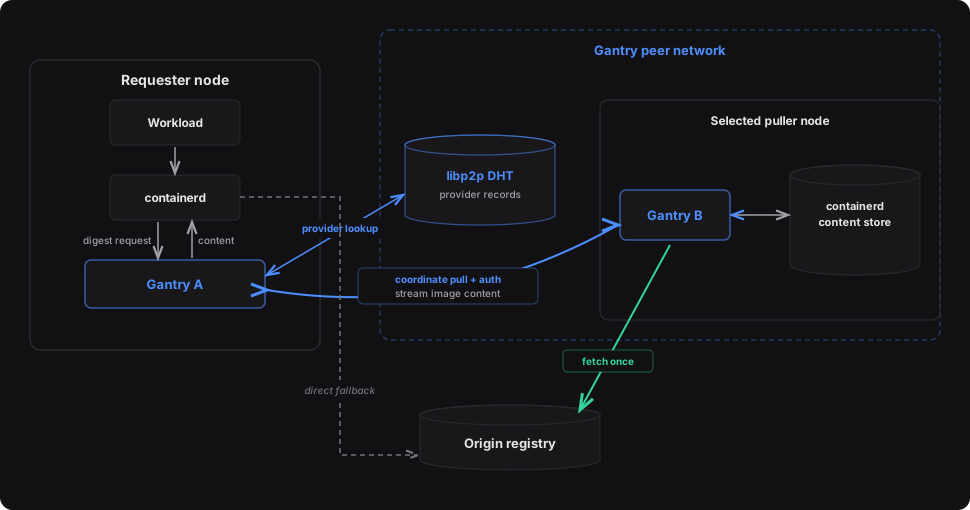
The DHT contains provider records, not image data. Manifests and layers stream directly from the selected Gantry peer, while containerd remains responsible for digest verification and the node-local content store.
Each network endpoint has one role:
| Port | Purpose | Transport |
|---|---|---|
| 5000 | Node-local containerd mirror | HTTP on node loopback through hostPort |
| 5001 | Peer manifest and layer transfer | Cleartext HTTP/2 inside the trusted cluster network |
| 5002 | Ask selected chairs to start origin pulls | TLS with chair identity validation |
| 4001 | libp2p discovery and coordination | Encrypted TCP and QUIC |
| 9095 | Readiness, health, and Prometheus metrics | HTTP |
How Gantry Handles a Pull
Containerd still resolves image tags through the origin registry. That produces immutable manifest and layer digests. Gantry handles the digest-addressed requests behind containerd’s mirror interface.
Local and warm pulls
- Gantry first opens the digest from the local containerd content store.
- On a local miss, Gantry asks the DHT for nodes that advertise the digest.
- Gantry filters stale, unavailable, self, and suspicious providers, then requests the content from a remaining peer.
- The peer reads the bytes from its containerd store and streams them over the transfer endpoint.
- The requester hashes the stream while containerd performs the final digest verification and commits the content.
- After the commit, the requester advertises itself as another provider.
Supply therefore grows during a rollout. Nodes that complete a layer can serve it to the next requesters instead of sending every request back to the original seed.
If a peer stream ends partway through, Gantry can preserve the verified offset and resume from another provider with an HTTP Range request instead of restarting the entire transfer.
Cold pulls
When the DHT has no provider, Gantry selects a bounded origin-puller cohort:
- Gantry reads the current Kubernetes Lease assignments for the chair pool.
- Every requester ranks the same chair slots for the digest using highest-random-weight selection.
- The highest-ranked group receives concurrent requests to start the origin pull. Each selected chair starts at most one local pull for the digest.
- A chair commits the content to its containerd store and advertises itself.
- Waiting requesters discover the provider and continue through the warm path.
The default configuration has 64 chair slots and a full-pool seed target of eight. Different digests produce different rankings, which distributes origin work across the pool without a central per-layer coordinator.
Gantry routes content by digest. Tag resolution still reaches the origin, so the exact reduction in registry requests depends on image composition and rollout size. Large layers distributed to many nodes receive the greatest benefit.
Failure recovery
Gantry classifies failures so one bad provider does not restart the entire rollout:
| Condition | Behavior |
|---|---|
| Peer returns 404 | Mark the provider stale for the digest and try another provider. |
| Peer returns 429 | Treat the peer as busy and reselect without quarantining it. |
| Peer is unavailable | Temporarily avoid that peer. |
| Stream stops | Resume the verified prefix from another provider when possible. |
| Digest mismatch | Reject the transfer and quarantine that provider for the digest. |
| Chair is already pulling | Treat the response as progress and wait for a provider advertisement. |
| Selected chair group makes no progress | Move to the next ranked group after bounded rechecks. |
| Warm providers are exhausted | Return a retriable response so containerd can use its next configured host. |
| Chair ranking is exhausted | Evaluate the guarded direct-origin fallback or return a retriable response. |
The guarded direct-origin fallback checks DHT bootstrap and health, deduplication, local rate capacity, a randomized delay, and one final provider lookup before starting another registry pull. These gates favor retry over an uncoordinated registry stampede.
Security and integrity
- Containerd verifies every requested digest before using the content.
- Gantry also hashes live peer streams and quarantines a provider after a mismatch.
- libp2p discovery and coordination traffic is encrypted.
- Chair origin-pull requests use TLS and validate the current Lease holder’s identity.
- The high-volume peer transfer endpoint uses cleartext HTTP/2. Restrict port 5001 to trusted Gantry peers with NetworkPolicy or equivalent network controls.
- The containerd mirror is bound to node loopback through hostPort 5000.
- Request-scoped registry credentials are not persisted by Gantry.
Deployment options
Gantry is available in two deployment models:
- Operator managed: the Unbounded operator owns the Gantry configuration, image, RBAC, chair Leases, and DaemonSet as part of an Unbounded cluster.
- Standalone Helm chart: third-party Kubernetes clusters can install and upgrade Gantry directly from the published OCI chart.
Use only one ownership model in a cluster. The standalone chart detects the operator-managed priority class and refuses to take ownership of the same resources.
Installation
1. Confirm Compatibility
The standalone chart supports Linux nodes running containerd. Before installing,
confirm that every selected node exposes /run/containerd/containerd.sock and
that containerd reads registry host configuration from
/etc/containerd/certs.d.
The chart does not modify or restart containerd. Provision the certs.d
setting through your node-management system. For standalone installations, the
chart runs a node-config DaemonSet that continuously reconciles the Gantry
mirror route shown below. The Unbounded agent owns that route instead on
operator-managed nodes, where the chart’s node-config resources are disabled.
The default route written on each node is:
# /etc/containerd/certs.d/_default/hosts.toml
[host."http://127.0.0.1:5000"]
   capabilities = ["pull", "resolve"]
   dial_timeout = "200ms"
Containerd must already have its CRI registry config_path set to
/etc/containerd/certs.d. The chart mounts the runtime directory and expects
the socket at /run/containerd/containerd.sock by default; use the
containerd.* chart values for a different layout.
Do not install the chart on a cluster where the Unbounded operator manages
Gantry. Both paths check PriorityClass/gantry-low and reject ownership by the
other manager.
2. Install the OCI Chart
Find the release on the
Unbounded releases page. The
chart version omits the release tag’s leading v:
export GANTRY_VERSION="<release-without-v>"
export GANTRY_IMAGE_DIGEST="sha256:<digest-from-release-bom>"

helm upgrade --install gantry oci://ghcr.io/azure/charts/gantry \
   --version "$GANTRY_VERSION" \
   --namespace gantry-system \
   --create-namespace \
   --set image.digest="$GANTRY_IMAGE_DIGEST" \
   --set gantry.upstreamRegistries[0].name=registry.example.com \
   --set gantry.upstreamRegistries[0].endpoint=https://registry.example.com \
   --wait \
   --timeout 15m
The chart owns the Gantry ConfigMap, image, RBAC, PriorityClass, chair Leases,
agent DaemonSet, and node-config DaemonSet. The node-config process checks its
_default/hosts.toml every five seconds and atomically restores it after drift
or a node upgrade reset. Upgrade those resources through helm upgrade, not
direct edits. Set nodeConfig.enabled=false only when another node-management
system owns mirror routing.
During graceful disable or uninstall, the node-config pod removes
hosts.toml only when it still matches the chart payload. Nodes unavailable
during uninstall may retain the file and should be checked before the Gantry
endpoint is considered fully removed.
3. Configure Upstream Registries
Set gantry.upstreamRegistries in your values file. This list is an opt-in allowlist: add only the
origin registries whose image pulls you want Gantry to accelerate. Registries
that are not configured here continue using containerd’s normal direct-origin
path and are not distributed through Gantry.
gantry:
   upstreamRegistries:
      - name: registry.example.com
         endpoint: https://registry.example.com
The name must match the registry host in the image reference and in
containerd’s certs.d directory. Include the port when the image reference
uses a non-default port. Gantry requires at least one accelerated upstream
registry.
4. Private Registry Authentication
Requester-Delegated Authentication
The workload supplies credentials in the normal Kubernetes way, such as an
imagePullSecret or a kubelet credential provider. For a private HTTPS
registry, the flow is:
- Containerd sends an unauthenticated digest request to its local Gantry agent.
- Gantry probes the registry’s verified HTTPS
/v2/endpoint and relays its Basic or BearerWWW-Authenticatechallenge. - Containerd answers the challenge using the credential supplied by kubelet or CRI. For Bearer authentication, containerd exchanges that credential at the registry’s HTTPS token service and sends Gantry the scoped token.
- Gantry carries the request-scoped authorization to the selected origin
puller. The selected node does not need its own registry identity or access
to the requester’s
imagePullSecret. - Gantry discards the authorization after the request. It does not persist the credential or fall back to the puller’s identity if the registry rejects it.
Requester-delegated private-registry authentication requires an HTTPS origin. Private plaintext HTTP registries are not supported by this mode.
Shared-Identity Authentication
Shared identity is a compatibility mode for environments where kubelet or CRI cannot provide a usable request credential. It gives every Gantry agent the same registry identity.
To enable it, create Secret/gantry-registry-credentials in the release
namespace and set the matching registry’s credentialsPath chart value.
The file contains a username:password pair keyed by the registry name.
Gantry reads configured credential files eagerly during startup. A missing
file causes the pod to fail, so do not add credentials_path unless the Secret
is present. Prefer requester-delegated authentication when possible because it
avoids distributing a shared registry credential to every node.
5. Verify Distribution
First verify one agent directly. Select a pod and forward its health and metrics listener:
GANTRY_POD=$(kubectl -n gantry-system get pods \
    -l app.kubernetes.io/name=gantry \
    -o jsonpath='{.items[0].metadata.name}')

kubectl -n gantry-system port-forward "pod/${GANTRY_POD}" 9095:9095
In another shell:
curl -fsS http://127.0.0.1:9095/readyz
curl -fsS http://127.0.0.1:9095/metrics
Roll out the same multi-layer image to at least two nodes, then inspect these metrics:
| Signal | Expected result |
|---|---|
p2p_dht_health_score | Reaches at least 0.7 after the routing table forms. |
gantry_storage_mode_info{mode="containerd"} | Equals 1 on every agent. |
p2p_cache_hit_total | Increases when the local containerd store satisfies mirror requests. |
p2p_peer_fetch_total{outcome="hit"} | Increases when a node receives content from a peer. |
p2p_origin_pull_total | Increases only on designated origin pullers during a cold rollout. |
gantry_origin_bytes_total{kind} | Counts bytes read from upstream registries, including partial transfers and retries. |
gantry_peer_fetch_bytes_total{kind} | Counts bytes received from peer Gantry agents. |
gantry_peer_serve_bytes_total{kind} | Counts bytes transmitted to peers; range requests count only the transmitted range. |
gantry_mirror_bytes_served_total{kind,source} | Counts bytes served to local containerd, split by cache, peer, or origin. |
p2p_origin_fallback_total | Remains near zero during healthy operation. |
gantry_advertise_reconcile_total | Continues increasing as Gantry reconciles containerd content with the DHT. |
gantry_containerd_lease_created_total | Increases when coordinated background pulls ingest new content. |
Use Racer as the Backend
The installation and distribution flow above describe Gantry’s default containerd backend. In Racer mode, Racer caches image content and shares it between nodes. Gantry still serves the local registry mirror, and it reads from upstream registries when Racer asks for content it does not have. Gantry does not use containerd storage or its own peer network in this mode.
Racer mode needs the operator-managed Gantry install and the Racer node requirements. The standalone Helm chart does not support Racer mode.
Turn On Racer Mode
Enable Gantry on a Site. Gantry is on by default for every Site unless
spec.components.gantry.enabledisfalse.Create a cluster-scoped cache named
gantry:apiVersion: racer.unbounded-cloud.io/v1alpha1 kind: ClusterCache metadata: name: gantryDo not set
spec.originon this cache. Gantry is its origin. Ifspec.originis set, the operator keeps Gantry in default mode and reports the reasonRacerOriginConflict.
Creating any ClusterCache makes the operator install Racer. When the gantry
cache exists and Gantry is enabled, the operator changes the gantry
DaemonSet in unbounded-system:
- It sets
GANTRY_RACER_ENABLED=true. - It mounts the Racer sockets from
/run/racer/gantry/clientand/run/racer/gantry/origin. - It copies node affinity, node selector, and tolerations from the
racer-dataplaneDaemonSet. Gantry then runs on every Racer node, so each node can serve origin reads for the cache.
The operator waits for racer-dataplane to exist before it makes these
changes. The cache does not install Gantry. If no Site enables Gantry, the
gantry cache is a plain Racer cache. The exception is a Gantry install the
operator already manages. It stays in place after every Site turns Gantry off,
and it still switches to Racer when the gantry cache exists. Workload
overrides on the gantry DaemonSet still apply on top of these changes.
Configure Upstream Registries
The operator creates ConfigMap/gantry-config in unbounded-system once and
does not overwrite it. Edit upstream_registries there:
upstream_registries:
  - name: "registry.example.com"
    endpoint: "https://registry.example.com"
In Racer mode:
namemust be a barehostorhost:port, with no scheme or path.- Gantry fetches only from registries in this list. Requests for other
registries return
404. - Gantry uses only requester-delegated credentials. It ignores
credentials_path. Delegated credentials need anhttpsendpoint;httpendpoints work only for anonymous registries. - Containerd and the transfer listener are not used.
Use the same gantry-config on every node. Any node can be asked to read from
an upstream registry.
Verify Racer Mode
Check that the DaemonSet runs in Racer mode and that each pod is ready:
kubectl -n unbounded-system get daemonset gantry \
    -o jsonpath='{.spec.template.spec.containers[?(@.name=="gantry")].env}'
kubectl -n unbounded-system rollout status daemonset/gantry
kubectl -n unbounded-system logs -l app.kubernetes.io/name=gantry -c gantry \
    --prefix --tail=-1 | grep "mirror startup gate released"
/readyz returns 503 until both Racer sockets accept connections. Then pull
an image from a configured registry and check these metrics:
| Signal | Expected result |
|---|---|
gantry_racer_mirror_requests_total{method,status,outcome} | Increases for each mirror request served through Racer. |
gantry_racer_mirror_bytes_total{method} | Counts bytes sent to local containerd. |
gantry_racer_mirror_duration_seconds | Shows mirror request latency. |
gantry_racer_origin_requests_total{method,status} | Increases when Racer asks this node to read from an upstream registry. Stays flat when Racer already has the content. |
gantry_racer_origin_bytes_total{kind} | Counts bytes read from upstream registries. |
Troubleshooting
- Every response from the Racer backend has a
Gantry-Racer-Request-IDheader. Search Gantry logs for that ID. - A
503from the mirror means Racer was not available. Gantry does not fall back to its own peer network in Racer mode. Containerd handles the error as it does for any failed mirror host. - A
404without aGantry-Racer-Request-IDheader means the registry is not inupstream_registries. - If Gantry pods stay not ready, check the
racer-dataplanepod on the same node and confirm that/run/racer/gantry/clientand/run/racer/gantry/originexist. - If the operator reports
RacerPendingfor Gantry, it is waiting for theracer-dataplaneDaemonSet.
Turn Off Racer Mode
Delete the cache:
kubectl delete clustercache gantry
The operator removes the Racer settings and rolls Gantry back to the containerd backend. Racer stays installed while other ClusterCaches exist.