Routing Flows
Packet-level routing flows for eBPF and netlink dataplanes, and protocol selection.
This document describes the detailed packet-level routing flows for both dataplane modes. For architecture context, see Architecture.
eBPF Dataplane Mode (default)
The eBPF dataplane uses a single TC egress BPF program (unbounded_encap)
attached to the unbounded0 dummy interface. All overlay traffic is attracted
to unbounded0 via kernel routes and then steered to the correct tunnel
interface by BPF LPM lookups.
Key Interfaces
| Interface | Purpose |
|---|---|
unbounded0 | Dummy (NOARP). Holds pod-CIDR gateway IPs and supernet routes. TC egress BPF attached here. |
geneve0 | Flow-based GENEVE (UDP 6081). |
vxlan0 | Flow-based VXLAN. |
ipip0 | Shared IPIP tunnel. |
wg<port> | WireGuard. wg51820 = mesh; wg51821+ = gateway ports. |
cbr0 | Pod bridge. |
Intra-Site Mesh (GENEVE)
Pod-to-pod traffic between two nodes in the same site:
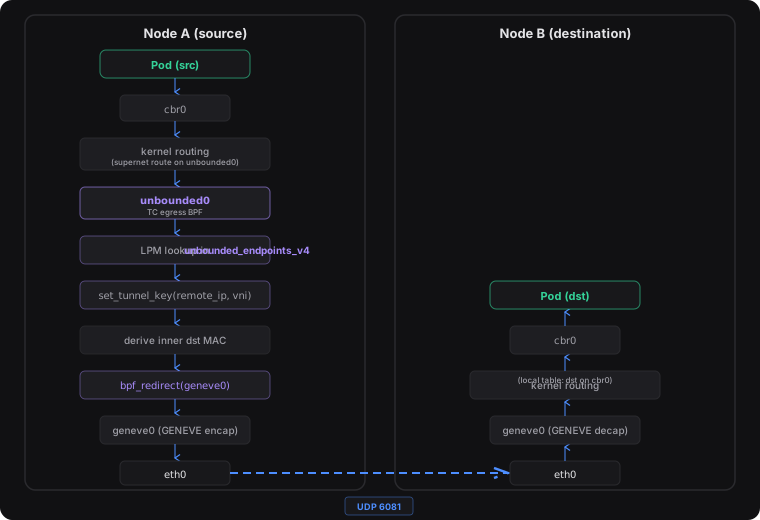
Step by step:
- Pod egress: Packet exits the pod via
cbr0(CNI bridge). - Kernel routing: Supernet route (e.g.,
100.64.0.0/16 dev unbounded0 scope global) attracts packet tounbounded0. - TC egress BPF:
unbounded_encapruns on TC egress ofunbounded0. - LPM lookup: Longest-prefix-match in
unbounded_endpoints_v4(or v6). - Tunnel metadata: If
TUNNEL_F_SET_KEYis set,bpf_skb_set_tunnel_key()is called with remote underlay IP, VNI, and TTL=64. - Inner MAC rewrite: Destination MAC set to
02:<ip[0]>:<ip[1]>:<ip[2]>:<ip[3]>:FF. - Redirect:
bpf_redirect(geneve0)sends packet to GENEVE driver, which encapsulates in UDP 6081. - Network transit: Outer UDP/IP packet traverses the underlay LAN.
- Decapsulation: Remote kernel receives on port 6081, decapsulates via
geneve0. - Local delivery: Inner packet routed to
cbr0and delivered to the destination pod.
Cross-Site via Gateway (WireGuard)
Traffic between pods in different sites, transiting through gateway nodes:
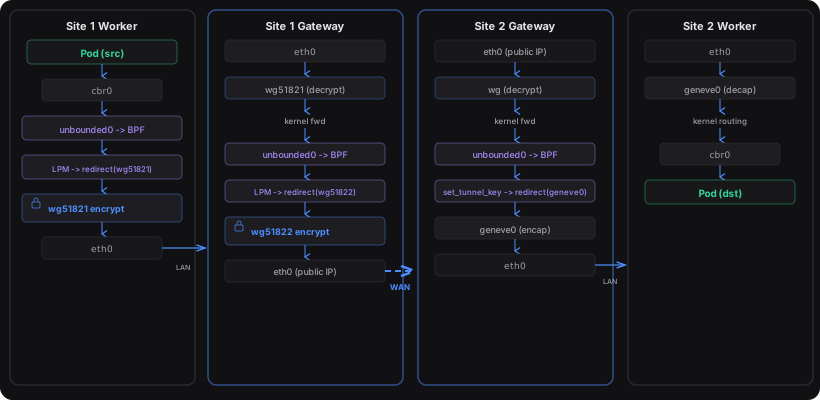
Step by step:
- Worker BPF LPM lookup finds WireGuard endpoint entry (no
TUNNEL_F_SET_KEYflag).bpf_redirect(wg51821)sends packet to WireGuard. - WireGuard encrypts and sends UDP to Site 1 gateway.
- Gateway decrypts, forwards via
unbounded0. BPF lookup resolves towg51822(gateway-to-gateway WireGuard). - Re-encrypted, sent over WAN to Site 2 gateway.
- Site 2 gateway decrypts, BPF resolves destination to GENEVE.
- GENEVE encap sent to destination worker over LAN.
- Worker decapsulates and delivers to pod.
Reply Path and Symmetric Routing
Gateway nodes ensure reply packets take the same WireGuard tunnel as the request using connmark, fwmark, and policy routing:
Framework:
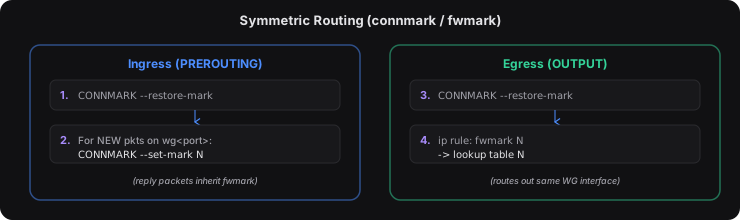
Each gateway WireGuard interface gets its own:
- Routing table: Table number = WireGuard port (e.g., 51821).
- Default route: Points out the corresponding WireGuard interface.
- ip rule:
fwmark <N> lookup <table>. - Marks are kept below
0x4000to avoid conflict with kube-proxy’sKUBE-MARK-MASQ.
Key Requirements
rp_filter = 0 on Tunnel Interfaces
Reverse-path filtering must be disabled on tunnel interfaces and
net.ipv4.conf.all because the kernel takes the maximum of per-interface and
all values:
/proc/sys/net/ipv4/conf/geneve0/rp_filter = 0
/proc/sys/net/ipv4/conf/vxlan0/rp_filter  = 0
/proc/sys/net/ipv4/conf/ipip0/rp_filter   = 0
/proc/sys/net/ipv4/conf/all/rp_filter     = 0
Deterministic MAC on Tunnel Interfaces
All tunnel interfaces use a MAC derived from the node’s underlay IP:
- IPv4:
02:<ip[0]>:<ip[1]>:<ip[2]>:<ip[3]>:FF - IPv6:
02:<last 4 bytes>:FF
Both the BPF program and Go code must produce identical values.
scope global on unbounded0 Routes
Supernet routes use scope global (not scope link) so they participate in
cross-interface forwarding on gateway nodes.
Single Deferred BPF Map Reconcile
BPF map entries are accumulated in pendingBPFEntries, then a single
reconcilePendingBPFEntries() call atomically deletes stale entries and
upserts desired entries. This prevents partial/inconsistent state.
Netlink Dataplane Mode (legacy)
The netlink dataplane creates per-peer tunnel interfaces and uses kernel routing tables.
Intra-Site Mesh (GENEVE)
Each peer gets gn<decimal_ip> (uint32 of peer’s underlay IPv4). The interface
has a fixed remote endpoint and VNI; kernel routes for the peer’s pod CIDRs
point to it.
Per-Peer IPIP
Each peer gets ip<decimal_ip>. Minimal overhead (20 bytes), no VNI
multiplexing, no encryption.
Shared VXLAN
A single vxlan0 interface with per-peer routing via lightweight tunnel
encap metadata:
ip route add <peer_cidr> encap ip src <local_ip> dst <peer_ip> dev vxlan0
WireGuard in Netlink Mode
Identical to eBPF mode. Kernel routes point directly to wg<port> interfaces.
Protocol Selection
Scope Hierarchy
| Link Type | Governing CRD |
|---|---|
| Same-site mesh | Site |
| Peered nodes (diff sites) | SitePeering |
| Worker to gateway pool | SiteGatewayPoolAssignment |
| Same-pool gateway mesh | GatewayPool |
| Gateway-pool to gateway-pool | GatewayPoolPeering |
Resolution Algorithm
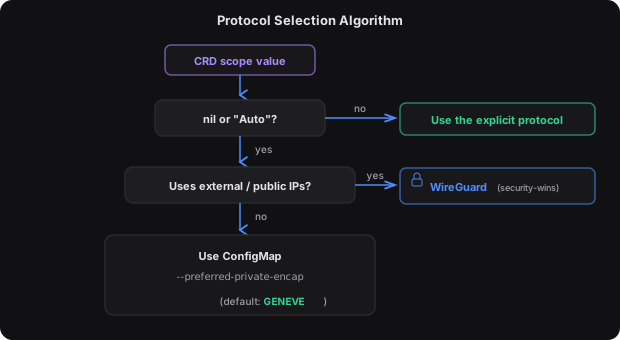
SGPA Override and Fallback
The SiteGatewayPoolAssignment tunnelProtocol overrides the Site setting for
worker-to-gateway links. When SGPA value is Auto or nil and the gateway is
in the same site, the system falls back to the Site’s tunnelProtocol (only
if explicitly set).
External Gateway Pools
External pools (default type) always resolve to WireGuard for cross-site, non-network-peered links.
Where Protocols Apply
| CRD Field | Controls |
|---|---|
Site.tunnelProtocol | Intra-site mesh tunneling |
SitePeering.tunnelProtocol | Directly peered site tunneling |
SiteGatewayPoolAssignment.tunnelProtocol | Worker-to-gateway tunneling |
GatewayPool.tunnelProtocol | Same-pool gateway mesh tunneling |
GatewayPoolPeering.tunnelProtocol | Cross-pool gateway tunneling |
Next Steps
- Architecture – System design and data flows.
- Configuration – All flags and settings.
- Operations – Deployment, monitoring, and troubleshooting.