Project Overview
What Project Unbounded is, the problem it solves, and how its components work together.
The Problem
Kubernetes was designed for nodes that share a network. Cloud-managed clusters (EKS, AKS, GKE) provision all worker nodes inside a single VPC, and on-prem clusters assume a flat LAN. This model breaks when you need compute in multiple locations:
- A second cloud region or a different provider entirely.
- GPU compute from specialized providers like Nebius, CoreWeave, or OCI.
- On-premises hardware behind a NAT or firewall.
- Edge devices at remote sites with limited connectivity.
Kubernetes itself has no opinion on how to provision nodes outside the cluster’s network, how to route pod traffic across sites, or how to PXE-boot bare-metal servers. These are gaps that Project Unbounded fills.
The Solution
Project Unbounded extends any conformant Kubernetes control plane so that worker nodes can run anywhere and join back to the cluster over encrypted tunnels. It supports four provisioning paths and a unified networking layer.
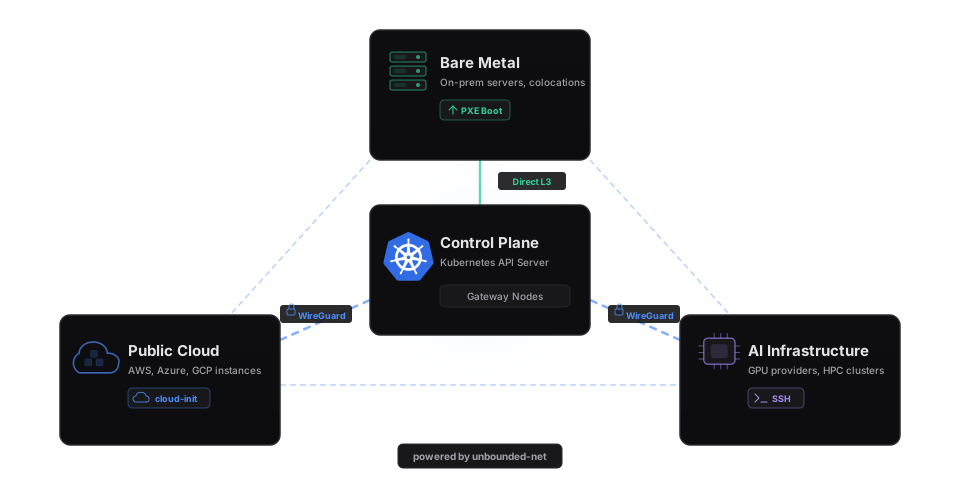
Components
unbounded-agent – Node Bootstrap Agent
unbounded-agent is a single binary that is delivered to each provisioned
host – via SSH, cloud-init, PXE image, or other mechanisms – to turn it into
a Kubernetes worker node. It detects host settings such as CPU architecture and
GPU devices, prepares the host, and creates a systemd-nspawn machine to run
the worker node components (kubelet, containerd, etc.) inside of it. Its
behavior is configured through a JSON config file.
See the Agent guide for a hands-on walkthrough and implementation details.
machina – SSH Provisioning Controller
machina is a Kubernetes controller that provisions remote Linux machines
over SSH. Given a Machine custom resource with SSH connection details, it:
- Probes the target host over TCP to confirm reachability.
- Connects via SSH (directly or through a bastion host).
- Copies and executes an install script that installs the unbounded agent and joins the node to the cluster using a bootstrap token.
- Watches for the corresponding
Nodeobject and transitions the Machine through its lifecycle phases.
machina is deployed as a Deployment in the unbounded-kube namespace and is
installed automatically by kubectl unbounded site init.
See the SSH guide for a hands-on walkthrough and the Architecture reference for implementation details.
Cloud API Provisioning – Karpenter-based Controller
The Cloud API provisioning path uses an Unbounded implementation of Karpenter to automatically provision instances from third-party cloud providers in response to unschedulable pods. This enables seamless scaling across GPU and compute providers such as Nebius, CoreWeave, OCI, Azure, AWS, and others.
When pods cannot be scheduled, the Karpenter controller creates Machine CRs
for the target provider. Machine controllers then call the provider’s API to
create instances, injecting a cloud-init user-data script that installs the
unbounded-kube agent on first boot. The agent contacts the API server and the
node joins the cluster automatically.
See the Cloud API guide for the full flow.
metalman – Bare-Metal PXE Controller
metalman is a controller for PXE-booting bare-metal servers into your cluster. It bundles four servers into a single binary:
- DHCP – Assigns IP addresses and points machines to the TFTP/HTTP boot artifacts. Supports both broadcast (interface mode) and unicast (relay mode).
- TFTP – Serves the initial PXE bootloader.
- HTTP – Serves kernel, initramfs, and configuration files.
- Health – Exposes readiness and liveness probes.
metalman integrates with Redfish BMCs for remote power management and TPM 2.0 for secure, attestation-based bootstrap token delivery.
See the Bare Metal concepts for a deeper explanation and the PXE guide for the hands-on walkthrough.
unbounded-net – Multi-Site Networking
unbounded-net is a CNI plugin and multi-site networking system. It provides transparent pod-to-pod connectivity across sites by:
- Allocating pod CIDRs per site and per node.
- Grouping nodes into Sites based on their internal IPs.
- Routing cross-site traffic through Gateway nodes using configurable tunnels (WireGuard, GENEVE, VXLAN, IPIP, or direct routing).
- Running an eBPF or netlink dataplane on each node to program routes.
See the Networking concepts for an introduction and the Networking reference for full configuration and CRD details.
Key Custom Resources
The system is driven by Kubernetes custom resources:
| CRD | API Group | Scope | Purpose |
|---|---|---|---|
| Machine | unbounded-cloud.io | Cluster | Represents a remote host to be provisioned (SSH, cloud API, or PXE) |
| Site | net.unbounded-cloud.io | Cluster | Groups nodes by internal IP range; allocates pod CIDRs |
| GatewayPool | net.unbounded-cloud.io | Cluster | Defines a set of gateway nodes for inter-site routing |
| SitePeering | net.unbounded-cloud.io | Cluster | Enables direct node-to-node tunnels between sites |
For full API specifications, see the CRD Reference (Machine) and Networking CRDs (Site/GatewayPool/SitePeering and related resources).
What Happens When You Add a Node
The flow varies by provisioning path, but all paths share the same final steps:
SSH path:
kubectl unbounded site initprepares the cluster: installs unbounded-net, creates Site and GatewayPool resources, generates a bootstrap token, and deploys the machina controller.kubectl unbounded machine registercreates aMachineresource with SSH connection details.- machina SSHs into the host, runs the install script, and waits for the node to register.
Cloud API path:
- An unschedulable pod is detected by the Karpenter controller.
- A
MachineCR is created for the target cloud provider. - The Machine controller calls the provider API and launches an instance with cloud-init user-data that installs the unbounded agent.
PXE path:
- A
MachineCR with PXE configuration is created. - metalman responds to the server’s DHCP/TFTP/HTTP boot requests and serves the OS image.
- The installed OS runs the unbounded agent on first boot.
All paths converge here:
- The unbounded agent on the node uses a bootstrap token to join the cluster and gets assigned a pod CIDR by unbounded-net.
- unbounded-net establishes tunnels (or routes over an existing private link) between the new node’s site and the gateway nodes.
- The Machine transitions to Ready.
Next Steps
- Getting Started – Install the plugin and join your first node in under 10 minutes.
- Cloud API Guide – Provision GPU instances from third-party clouds automatically.
- Networking Concepts – Understand sites, gateways, and tunnel types.
- Bare Metal Concepts – Learn how PXE boot and TPM attestation work.
- Architecture Reference – Deep dive into component internals.